Leave Your Message
Choosing a mini fan is rarely as simple as matching a diameter. Global buyers must consider airflow, static pressure, voltage, noise, installation space, and operating temperature. A compact housing can hide major performance differences. Two 40-millimeter fans may look identical, yet one may cool a control cabinet better.
Dr. Peter S. Nielsen, a rotating-equipment and airflow specialist, states, “The right fan is selected by the system’s resistance, not by appearance alone.” This principle guides our review of the leading Axial Fan Mini Fan categories. We will examine brushless DC fans, AC mini axial fans, USB-powered models, high-pressure versions, and water-resistant designs. Each type serves a different practical need. Some suit laptops and networking equipment. Others support medical devices, LED lighting, battery systems, or compact industrial enclosures.
Real-world details matter. A fan installed behind a dusty filter may lose airflow quickly. A quiet model may struggle against a narrow grille. A high-speed fan may cool effectively but create an uncomfortable tonal sound. Buyers should check the fan curve, connector type, bearing structure, protection rating, and expected service life. Certification requirements also vary by market.
There is no perfect universal model. That is easy to overlook. Even experienced purchasers can prioritize price too heavily. This guide compares performance, reliability, energy use, and installation flexibility. It also highlights common selection mistakes. The goal is practical judgment, not exaggerated specifications.
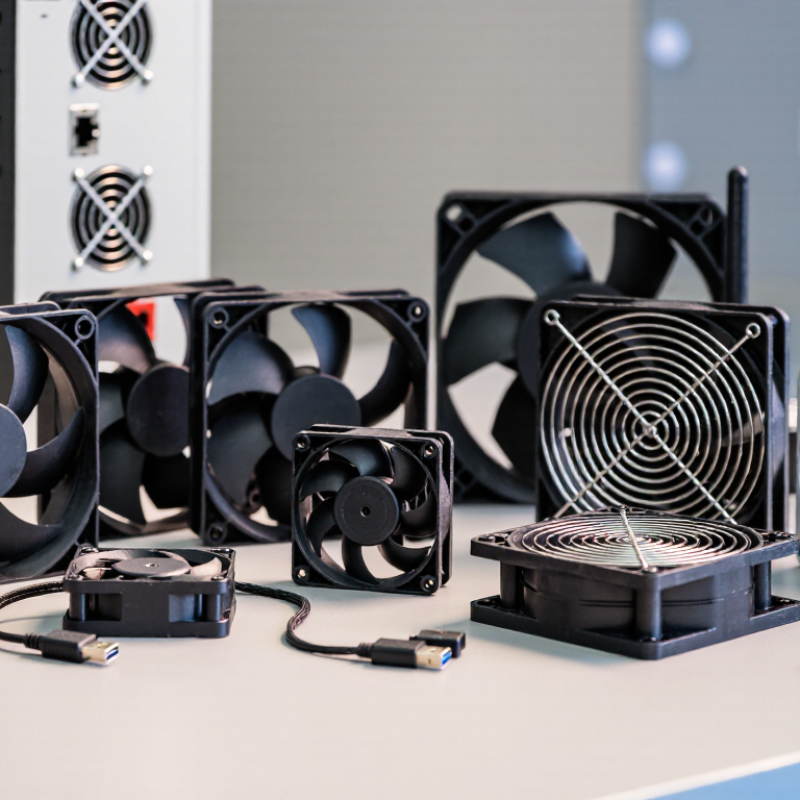
Top Types of Mini Axial Fans for Global Buyers
Mini Axial Fan Fundamentals: 25–172 mm Frames and P–Q Curves
Mini axial fans commonly use frames from 25 mm to 172 mm. Small does not mean simple. A 25 mm fan suits compact sensors, controllers, and handheld equipment. Larger 120 mm or 172 mm frames can move more air at lower rotational speeds. Common constructions include sleeve-bearing and ball-bearing designs. Sleeve bearings may reduce cost, while ball bearings often support longer operation in warmer environments.
A P–Q curve shows the relationship between airflow and static pressure. “P” represents pressure, while “Q” represents airflow. Free-air airflow is not the working result. Filters, grilles, ducts, and vents add resistance. The real operating point appears where the fan curve meets the system curve. Measure the restriction. A fan with impressive airflow may perform poorly behind a dense filter. I have seen selections based only on free-air figures, and the final cooling result was disappointing. Ambient temperature, mounting direction, voltage variation, and acoustic limits also deserve attention.
Tips: Compare curves at the required pressure, not only at zero pressure. Check the rated voltage and speed range. Allow space for intake and exhaust clearance. Confirm noise data under the same test conditions. Datasheets can be incomplete, so request tested P–Q data when the application is sensitive.
Representative engineering reference ranges for commonly available mini axial fan formats. Actual performance depends on blade geometry, motor design, inlet and outlet restrictions, operating voltage, and system impedance.
| Nominal Frame Size | Typical Fan Thickness | Common Supply Options | Typical Speed Range | Free-Airflow Range | Maximum Static Pressure | Typical Power Input | Typical Sound Level | Typical Bearing Type | Representative P–Q Curve Behavior | Common Applications |
|---|---|---|---|---|---|---|---|---|---|---|
| 25 × 25 mm | 6–10 mm | 5 V DC, 12 V DC | 6,000–12,000 rpm | 0.8–2.0 CFM 1.4–3.4 m³/h |
20–45 Pa | 0.15–0.45 W | 24–35 dB(A) | Sleeve or miniature ball bearing | Very compact airflow source; pressure drops quickly when grille or filter resistance increases. | Small sensors, compact electronics, optical equipment, and miniature enclosures. |
| 30 × 30 mm | 6–10 mm | 5 V DC, 12 V DC | 5,000–11,000 rpm | 1.5–3.5 CFM 2.5–6.0 m³/h |
30–70 Pa | 0.20–0.65 W | 24–37 dB(A) | Sleeve or ball bearing | Moderate pressure capability for its size; best suited to low-resistance ventilation paths. | Control boards, compact power supplies, network devices, and handheld instruments. |
| 40 × 40 mm | 10–20 mm | 5 V DC, 12 V DC, 24 V DC | 4,000–10,000 rpm | 3–7 CFM 5–12 m³/h |
45–100 Pa | 0.35–1.20 W | 25–40 dB(A) | Sleeve or dual-ball bearing | Balanced P–Q performance with a useful operating range for low to medium enclosure resistance. | Embedded computers, communication equipment, instrumentation, and compact chargers. |
| 50 × 50 mm | 10–20 mm | 5 V DC, 12 V DC, 24 V DC, 48 V DC | 3,500–9,000 rpm | 5–12 CFM 8.5–20 m³/h |
60–140 Pa | 0.50–1.80 W | 27–43 dB(A) | Sleeve or ball bearing | Suitable for moderate airflow and pressure; higher-speed versions provide a steeper pressure curve. | Industrial control cabinets, networking hardware, LED drivers, and small battery systems. |
| 60 × 60 mm | 15–25 mm | 12 V DC, 24 V DC, 48 V DC | 3,000–8,000 rpm | 8–20 CFM 13.5–34 m³/h |
70–180 Pa | 0.80–3.00 W | 28–46 dB(A) | Ball bearing or long-life sleeve bearing | Provides a practical compromise between free-airflow capacity and system pressure capability. | Industrial electronics, telecom equipment, compact servers, and power conversion systems. |
| 70 × 70 mm | 15–25 mm | 12 V DC, 24 V DC, 48 V DC | 2,500–7,000 rpm | 12–28 CFM 20–48 m³/h |
90–220 Pa | 1.00–4.00 W | 30–49 dB(A) | Ball bearing or sealed sleeve bearing | Offers improved airflow at moderate resistance; well suited to compact systems with filters or narrow ducts. | Automation panels, storage devices, test equipment, and telecommunications enclosures. |
| 80 × 80 mm | 15–32 mm | 12 V DC, 24 V DC, 48 V DC | 2,000–6,500 rpm | 18–40 CFM 30.5–68 m³/h |
100–260 Pa | 1.20–5.50 W | 31–52 dB(A) | Dual-ball bearing or sleeve bearing | Common general-purpose format with a broad operating envelope and multiple speed options. | Industrial PCs, power supplies, network switches, cabinets, and laboratory equipment. |
| 92 × 92 mm | 25 mm | 12 V DC, 24 V DC, 48 V DC | 2,000–6,000 rpm | 25–55 CFM 42.5–93.5 m³/h |
120–300 Pa | 1.50–6.50 W | 32–54 dB(A) | Dual-ball bearing or hydraulic sleeve bearing | Delivers higher airflow than 80 mm formats while maintaining useful pressure performance. | Rack equipment, industrial computers, inverter systems, and control cabinets. |
| 120 × 120 mm | 25–38 mm | 12 V DC, 24 V DC, 48 V DC | 1,500–5,000 rpm | 45–100 CFM 76.5–170 m³/h |
150–420 Pa | 2.00–12.00 W | 34–58 dB(A) | Dual-ball bearing or high-life sleeve bearing | Strong overall airflow capacity; high-pressure variants retain more flow as system resistance rises. | Server equipment, industrial drives, battery cabinets, HVAC controls, and power electronics. |
| 127 × 127 mm | 25–38 mm | 12 V DC, 24 V DC, 48 V DC | 1,500–4,800 rpm | 55–120 CFM 93.5–204 m³/h |
160–450 Pa | 2.50–14.00 W | 35–60 dB(A) | Dual-ball bearing | Provides a larger swept area and stable airflow for equipment requiring continuous heat removal. | Industrial cabinets, power supplies, UPS systems, and compact data-processing equipment. |
| 140 × 140 mm | 25–38 mm | 12 V DC, 24 V DC, 48 V DC | 1,300–4,500 rpm | 70–150 CFM 119–255 m³/h |
180–500 Pa | 3.00–18.00 W | 36–62 dB(A) | Dual-ball bearing or high-temperature sleeve bearing | Higher airflow at lower rotational speed; suitable for systems where acoustic performance matters. | Large control enclosures, industrial computing, energy storage, and power conversion equipment. |
| 150 × 150 mm | 25–51 mm | 12 V DC, 24 V DC, 48 V DC | 1,200–4,200 rpm | 85–180 CFM 144.5–306 m³/h |
200–550 Pa | 4.00–22.00 W | 37–64 dB(A) | Dual-ball bearing | Large-frame format for high-volume cooling; performance is strongly affected by guard and filter design. | Battery systems, industrial automation, telecom infrastructure, and high-power electronics. |
| 172 × 172 mm | 38–51 mm | 12 V DC, 24 V DC, 48 V DC, 115 V AC, 230 V AC | 1,000–3,800 rpm | 110–240 CFM 187–408 m³/h |
220–650 Pa | 6.00–35.00 W | 40–68 dB(A) | Dual-ball bearing or industrial sleeve bearing | High-volume axial cooling format with strong total heat-removal potential for larger equipment. | Industrial machinery, large cabinets, power converters, energy systems, and server-room equipment. |
Reading a P–Q curve: airflow is normally shown on the horizontal axis and static pressure on the vertical axis. The curve begins near maximum static pressure at zero airflow and approaches maximum airflow as system resistance decreases. For product selection, compare the fan curve with the system resistance curve at the intended operating point rather than selecting by free-airflow alone. Values above are representative ranges, not guaranteed specifications for a particular model.