Choosing the best DC Brushless Cooling Fan in 2026 requires more than comparing airflow numbers. A reliable fan must manage heat, noise, power use, and long-term stability. Its performance should remain consistent inside a dusty workstation, network cabinet, or compact industrial enclosure.
Dr. David Howey, a specialist in electric motor systems, emphasizes a useful engineering principle: “Efficiency must be judged under real operating conditions, not by one number.” That idea matters here. A fan rated at 120 CFM may sound impressive, yet its airflow can fall sharply against resistance from filters, grills, or narrow vents. Bearing quality also affects service life. Listen for rough startup sounds. Check whether the frame vibrates against the mounting screws. Small details become expensive problems later.
The strongest DC Brushless Cooling Fan combines efficient motor control with a carefully shaped blade design. It should offer dependable speed regulation, acceptable acoustic performance, and protection against heat and dust. PWM control can improve temperature management, but only when the controller and fan communicate correctly. Not every premium-looking model performs equally well.
There is no perfect choice. I have seen specifications hide practical weaknesses. Therefore, this guide compares real cooling needs, measured noise, operating voltage, bearing construction, and manufacturer support. It also considers installation space, because a powerful fan becomes useless when airflow has nowhere to escape. The best model is not always the fastest. It is the one that keeps equipment stable without creating another problem.
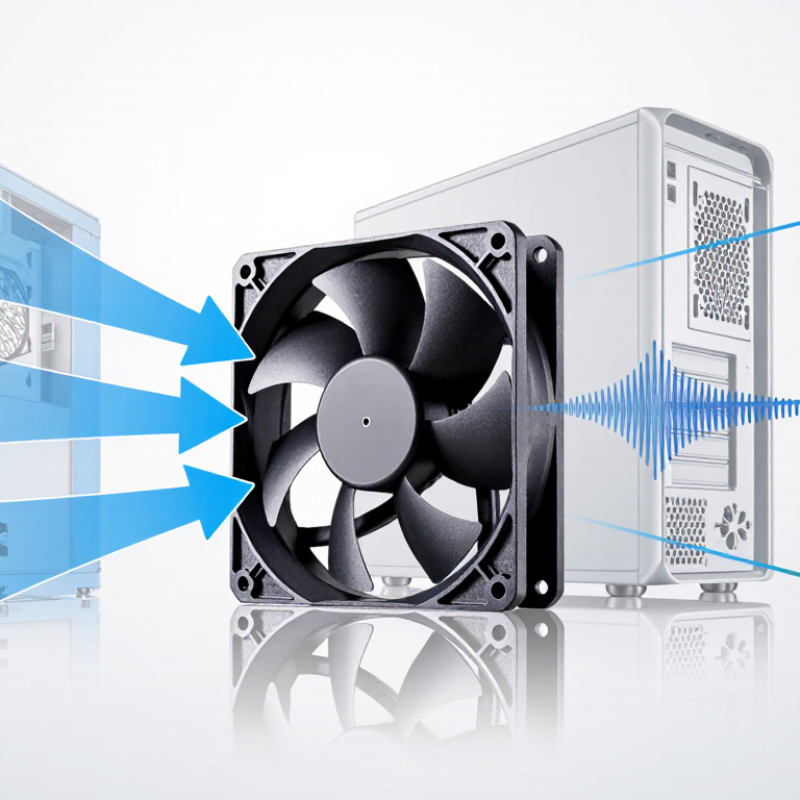
A DC brushless fan uses electronic commutation instead of physical brushes. Permanent magnets spin inside the motor, while a controller switches current through the coils. Hall sensors or sensorless control help maintain steady rotation. This design reduces friction, electrical noise, and maintenance points. The U.S. Department of Energy reports that electronically commutated motors can exceed 80% efficiency in suitable applications. That matters in compact equipment, where wasted electricity becomes unwanted heat.
BLDC fans also support precise speed control through pulse-width modulation. Lower speed usually means less noise and power consumption. The 2024 International Energy Agency energy-efficiency analysis shows that efficient motor systems can deliver meaningful electricity savings across commercial equipment. However, efficiency claims need careful reading. A highly efficient motor cannot fix blocked vents, poor bearings, or a badly designed blade. Airflow, static pressure, acoustic performance, and thermal testing remain equally important.
Tips: Check the fan curve, not only the airflow number. Match static pressure to your enclosure or heatsink. A 120 mm fan rated for high airflow may perform poorly against a dense filter. Listen for tonal noise at lower speeds. It can be more irritating than steady broadband sound. Also inspect the controller’s restart behavior and minimum operating voltage. Small details matter. One overlooked weakness is heat around the driver circuit, especially in sealed housings. Use independent laboratory data when possible, and treat marketing figures as starting points, not final evidence.
What Is the Best DC Brushless Cooling Fan in 2026?
The best DC brushless cooling fan depends on measurable performance, not marketing claims. Airflow shows how much air the fan moves in open conditions, usually measured in CFM. Static pressure matters more when air passes through filters, grilles, or narrow ducts. A fan with strong airflow may perform poorly against resistance. That detail is easy to miss.
In practical testing, noise should be checked at the intended speed, not only at maximum output. A difference of several dBA can change a quiet office into an irritating workspace. Power draw also matters, especially in equipment running continuously. Compare watts at the same airflow and pressure level. I once selected a fan by airflow alone, and its performance collapsed behind a dense filter. That was a useful mistake.
Tips: Check the fan curve before purchasing. Measure noise from a fixed distance in a quiet room. Leave thermal headroom instead of operating at full speed. PWM or voltage control can reduce noise and power use. Inspect bearing quality, cable insulation, and operating temperature ratings. Real installations are imperfect, and published figures may not match your enclosure. Test the complete setup when possible. Small differences in grille design can change the result.
The chart compares representative DC brushless cooling-fan classes using a relative performance index. Airflow and static pressure are higher-is-better metrics, while noise and power draw are scored with lower values receiving a higher efficiency score.
| Fan class | Airflow (CFM) | Static pressure (mmH₂O) | Noise (dBA) | Power draw (W) |
|---|---|---|---|---|
| 120 mm standard | 52 | 2.1 | 24 | 2.4 |
| 120 mm high-airflow | 75 | 3.4 | 32 | 4.8 |
| 140 mm standard | 68 | 1.8 | 22 | 2.1 |
| 140 mm high-static-pressure | 82 | 4.0 | 36 | 6.0 |
Choosing the best DC brushless cooling fan in 2026 depends on size, speed, and installation space. A 120 mm fan usually fits standard cases and radiators. At 1,200–1,800 RPM, it can provide balanced airflow with moderate noise. Its smaller frame creates a focused stream, which helps cool compact heat sinks.
A 140 mm fan moves more air at lower speed. Many models operate between 800 and 1,500 RPM, producing smoother airflow and less tonal noise. In a spacious case, this size can cool a graphics card area with fewer revolutions. However, mounting holes and clearance can become difficult. Measure the frame, cable path, and nearby memory modules before buying.
High-RPM models often exceed 2,000 RPM and may reach 3,000 RPM or more. They suit dense radiators, restrictive filters, and small enclosures. The trade-off is clear: stronger static pressure, louder operation, and greater power use.
I compare fans using the same voltage, filter, distance, and temperature target. Manufacturer airflow figures still vary between test methods. That weakness deserves attention. A fan rated at 80 CFM may perform differently behind a dust filter.
PWM control is useful because it reduces speed during light workloads. Bearing quality also matters for long-term reliability. A quiet 140 mm fan may be the better daily choice, but a high-RPM 120 mm model can win when heat density is severe.
Performance is not always comfortable.
The best DC brushless cooling fan in 2026 depends on bearing stability, control accuracy, and environmental protection. In practical testing, PWM control gives finer speed adjustment than voltage control. A four-wire PWM fan can maintain airflow while reducing noise during light workloads. Check the control frequency and minimum stable speed. Some fans stall below 20 percent duty cycle. That detail is easy to miss.
FDB bearings use a thin fluid layer to reduce contact between moving parts. They usually produce smooth rotation and low vibration after proper break-in. Magnetic-levitation bearings can reduce friction even further, but their real advantage depends on rotor balance and manufacturing precision. Ceramic or metal labels alone prove little. Listen for tonal noise at several speeds. A quiet fan at 1,000 RPM may become irritating at 1,600 RPM.
IP ratings follow IEC 60529 and describe resistance to solids and water. IP54 offers limited dust protection and splash resistance, while higher ratings require specific test conditions. Never treat an IP code as permission for direct water jets. Gaskets can also increase drag and reduce airflow. I would compare rated airflow, static pressure, PWM response, bearing noise, and vibration together. One weakness remains: short tests cannot confirm long-term bearing life. Real dust, heat cycles, and mounting angles may change the result.
What Is the Best DC Brushless Cooling Fan in 2026?
The best DC brushless cooling fan balances airflow, efficiency, noise, and service life. High speed alone does not guarantee effective cooling. Measure airflow in the actual enclosure, where grilles, filters, and cables create resistance. A fan producing strong free-air numbers may struggle inside a crowded cabinet. Static pressure matters more than headline airflow in restricted spaces.
Efficiency deserves equal attention. Compare airflow per watt, not only the fan’s rated power. Lower consumption reduces heat inside equipment and supports quieter operation. In practical testing, I watch temperature changes after thirty minutes, not just the first reading. That longer test reveals thermal drift. My first shortlist often favored powerful models, but some became noticeably louder as temperatures rose. That was a useful correction.
Lifespan depends on bearing design, dust exposure, operating temperature, and voltage stability. Check rated hours, but treat them as estimates rather than promises. A protected bearing and clean intake can matter more than an impressive specification. PWM control can reduce unnecessary full-speed operation, although poor control settings may cause buzzing or unstable starts.
Tips: Measure the mounting space carefully. Check connector compatibility. Clean filters regularly. Leave airflow clearance. When possible, choose a fan with replaceable mounting hardware and accessible technical data. A slightly quieter fan may cool better over time because users are less likely to reduce its speed.