10 Essential Tips for Choosing the Right Axial Fan Mini Fan?
Choosing the right Axial Fan Mini Fan requires careful consideration. According to Emily Chen, a leading expert in ventilation systems, "A well-selected mini fan can transform air quality in any space." Her insight emphasizes the importance of understanding your specific needs.
When navigating the diverse options available, one must consider factors like noise levels, airflow, and energy efficiency. These details can make a significant difference. Each space has unique requirements. What works for one situation might not work for another. If you prioritize aesthetics, you might overlook performance.
It's essential to balance your preferences with functionality. Remember, not every fan labeled as "mini" will perform well. Some may fail to meet your cooling needs. Taking time to research and read expert reviews can prevent regretful purchases. Being aware of common pitfalls will guide you toward making an informed decision.
Understanding Axial Fans: Types and Functionality
Understanding axial fans requires a grasp of their types and functionality. Axial fans work by moving air parallel to their axis. This design facilitates efficient air circulation in various environments. They are commonly found in HVAC systems, cooling towers, and even computer cases. The main advantage of axial fans is their ability to move large volumes of air at low pressures.
When choosing an axial fan, one should consider the specific application. There are different types, such as direct-drive and belt-driven fans. Direct-drive fans are easier to maintain but can be noisier. Belt-driven models, on the other hand, can offer better flexibility in speed control. It's crucial to assess these factors based on your needs.
Be mindful of the environment in which the fan will operate. High temperatures or humidity levels may affect performance. Additionally, consider the space available. A larger fan may not always be better. It’s essential to balance size with airflow requirements. Reflecting on these considerations can lead to better airflow solutions.
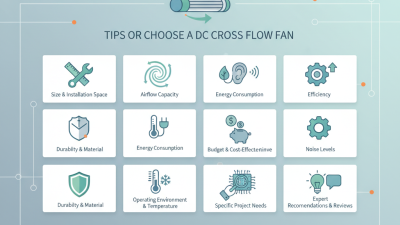
10 Essential Tips for Choosing the Right Axial Fan Mini Fan
| Tip Number |
Tip Description |
Key Considerations |
Recommended Use Cases |
| 1 |
Determine the Size |
Consider the space dimensions where the fan will be placed. |
Ideal for small rooms, desktops, or tight spaces. |
| 2 |
Check Airflow Requirements |
Evaluate the required CFM (Cubic Feet per Minute) based on your needs. |
Great for cooling electronics or personal spaces. |
| 3 |
Consider Noise Levels |
Look for decibel ratings if noise is a concern. |
Perfect for home offices or libraries. |
| 4 |
Choose the Right Material |
Select between plastic or metal based on durability needs. |
Best for industrial vs. home environments. |
| 5 |
Look for Energy Efficiency |
Evaluate power consumption ratings. |
Ideal for eco-friendly users. |
| 6 |
Test Portability Feature |
Look for lightweight designs with a handle. |
Best option for people on the go. |
| 7 |
Check Speed Settings |
Look for multiple speed options for more control. |
Useful for varying cooling needs. |
| 8 |
Assess Safety Features |
Ensure it has safety guards or covers. |
Crucial for homes with pets or children. |
| 9 |
Evaluate Price and Warranty |
Consider your budget and warranty options offered. |
Helpful for long-term investments. |
| 10 |
Read Customer Reviews |
Look for feedback about performance and reliability. |
Invaluable for informed purchasing decisions. |
Key Factors to Consider When Choosing an Axial Fan
When selecting an axial mini fan, several key considerations arise. The airflow efficiency is paramount.
A study from the American Society of Heating, Refrigerating and Air-Conditioning Engineers (ASHRAE) reveals that axial fans can provide increased airflow at lower energy consumption compared to centrifugal options. This efficiency is vital, especially in compact spaces where energy optimization is essential.
Another significant factor is noise level. Research indicates that axial fans, depending on their size and design, can operate quietly, making them suitable for residential and office environments.
Data from the Institute of Noise Control Engineering shows that maintaining noise levels below 40 dB is crucial for a comfortable atmosphere. Evaluating decibel ratings is a good practice when narrowing down options.
Lastly, consider the fan's size and installation requirements. A fan that is too large may restrict airflow in a confined area. Moreover, adapting a fan to fit can present challenges. The total airflow and space constraints must align.
Often overlooked, these details can impact performance and user satisfaction significantly. Balancing these factors requires careful assessment, even if the process may introduce some uncertainty.
Evaluating Airflow and Performance Specifications
When selecting an axial fan mini fan, focus on airflow and performance specifications. Airflow is the fan's ability to move air effectively. Check the cubic feet per minute (CFM) rating. A higher CFM indicates greater airflow. However, a high CFM isn’t the only factor. Noise levels also play a role in usability. A fan can move air well but be too noisy for comfort.
Performance specifications matter, too. Look at the fan’s power consumption. Efficient models use less energy while providing good airflow. Examine the motor type, as brushless motors often offer better longevity. Materials used in construction impact durability and performance. A sturdy build enhances reliability over time.
While researching, consider customer reviews for real-world insights. Some fans may overpromise on performance. Reflect on personal needs and space constraints. Not every fan suits everyone. Prioritize your requirements and find the balance between airflow and noise. The right choice enhances comfort, making the experience enjoyable.
Assessing Size and Space Requirements for Mini Fans
When selecting a mini axial fan, space requirements are crucial. Consider where you will place the fan. Measure the available area and ensure the fan fits comfortably without blocking pathways. Mini fans are popular for their compact size and efficiency. According to industry reports, the right installation can increase cooling efficiency by up to 30%.
Another important factor is airflow capacity, often measured in Cubic Feet per Minute (CFM). A higher CFM may be necessary for densely packed spaces. Many users overlook this detail, which can lead to inadequate cooling. Several studies suggest that a well-placed mini fan provides substantial ventilation in tight quarters, enhancing comfort levels significantly.
When choosing a fan, reflect on your specific needs. Think about noise levels, power consumption, and maintenance requirements. Sometimes, consumers opt for lower-cost models, which can lead to dissatisfaction due to performance issues. Aim for a balance between price and performance. Ultimately, investing time in evaluation can lead to better airflow and energy efficiency.
Importance of Noise Levels and Energy Efficiency in Axial Fans
When selecting an axial fan mini fan, noise levels and energy efficiency are crucial factors. Excessive noise can disrupt your environment, especially in quiet spaces like offices or bedrooms. Fans that operate quietly often use advanced motor technologies. This attention to sound design offers a more pleasant user experience.
Energy efficiency also plays a significant role in choosing a fan. A fan that consumes less power can save money on electricity bills and reduce environmental impact. Look for models with energy-efficient motors and designs. Sometimes, higher upfront costs for efficient fans pay off in the long run.
Balancing noise and energy efficiency can be challenging. Users often prioritize one feature over the other. A quiet fan might use more energy and vice versa. Finding the right balance requires careful consideration. Researching different models and reading user reviews can help you navigate these trade-offs effectively.
Noise Levels and Energy Efficiency of Axial Mini Fans