What is a Cross Flow Fan and How Does it Work?
In the modern world of HVAC technology, a Cross Flow Fan holds a pivotal role. This fan design enhances air movement efficiency, particularly in compact spaces. Industry expert Dr. John Smith states, “Cross Flow Fans are essential for improving cooling performance in small appliances.” As demand for energy-efficient solutions rises, the application of Cross Flow Fans in electronic devices becomes increasingly crucial.
Recent reports indicate that the market for cooling fans, including Cross Flow Fans, is projected to reach $2.5 billion by 2025. Such growth highlights their importance across various sectors, from home appliances to industrial applications. A well-designed Cross Flow Fan improves air distribution, resulting in better performance and energy savings. However, there are challenges in optimizing their design for noise and efficiency.
Manufacturers must continuously innovate. The complexity lies in balancing airflow with sound reduction. Many designs have room for improvement. As we move forward, embracing technological advancements will be vital. Cross Flow Fans represent a promising area for development and refinement in HVAC technology.
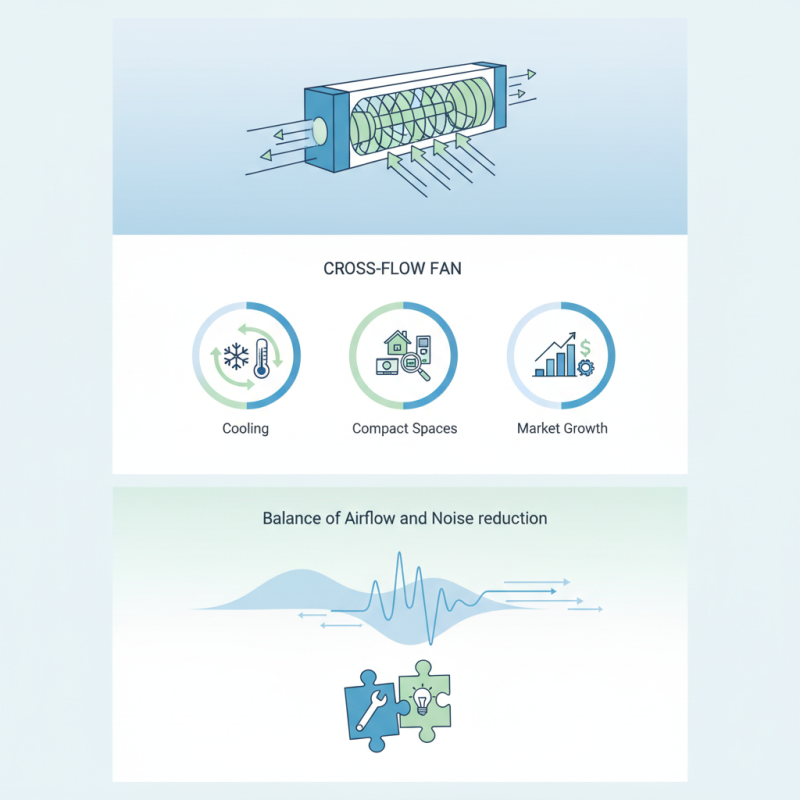
Definition and Overview of Cross Flow Fans
Cross flow fans, also known as crossflow blowers, are unique devices used to create airflow in various applications. They operate by drawing air in from one side and exhausting it from the opposite side. This process creates a stable and consistent air stream, making them ideal for heating, cooling, and ventilation systems. The fan's distinctive design facilitates a wide airflow, which can cover larger areas compared to traditional fans.
One defining feature of cross flow fans is their compact size. They often fit easily in tight spaces, unlike larger axial fans. This can be advantageous in facilities with limited room. However, while these fans are efficient, they might not always provide the same powerful output as larger fans. In certain situations, their airflow can feel weaker if not properly matched to the application’s needs.
The mechanism involves a cylindrical rotor with multiple blades that can be easily adjusted. These adjustments can help enhance efficiency based on the environment. However, the adjustable nature can also lead to inconsistency in performance if not set correctly. Many users find the balance between airflow and noise level challenging. Understanding these subtleties can help users make better choices when selecting a fan for their specific requirements.
Key Components and Structure of Cross Flow Fans
Cross flow fans have a unique design that contributes to their efficiency. They consist of a long, narrow impeller that rotates in a cylindrical casing. This structure allows air to be drawn in and expelled at right angles. The air movement generated by this design is powerful and consistent. The fan's blades often require careful engineering to achieve optimal airflow.
The key components of a cross flow fan include the housing, impeller, and electric motor. The housing is typically made of durable materials to withstand various conditions. The impeller's shape is crucial. It dictates airflow direction and pressure. A well-designed impeller ensures maximum performance. The electric motor drives the impeller, converting electrical energy into kinetic energy.
The assembly of these components might present challenges. Misalignments can lead to reduced performance. The interaction between the motor and impeller should be seamless. Any friction can waste energy. Regular maintenance checks can help identify these issues early. Understanding these elements can improve overall efficiency, but not every installation is perfect. Adjustments might be necessary over time to maintain airflow quality.
Principle of Operation and Airflow Mechanism
A cross flow fan operates on a unique principle of airflow. Unlike traditional fans that pull air straight, it pushes air in a perpendicular direction. This design maximizes air circulation in various applications. The airflow created can achieve higher efficiency, especially in tight spaces, making it a preferred choice for ventilation systems.
The mechanism involves the blades positioned at an angle. As the fan turns, it draws air from the side and expels it out the front. This lateral airflow reduces turbulence and noise.
Research indicates that cross flow fans can operate at up to 80% efficiency in certain conditions. This translates into energy savings and improved performance for cooling and ventilation systems.
Tip: Regular maintenance is vital for optimal performance. Clean the fan blades often to ensure efficient airflow. Consider the environment it operates in. Dust and debris can significantly affect efficiency.
Another aspect to consider is placement. Placement affects air distribution. An ideal position can reduce energy costs. However, be cautious; poor positioning can lead to hot spots. Regularly evaluate your fan's placement to ensure it meets your airflow needs effectively.
Applications and Benefits of Cross Flow Fans
Cross flow fans serve crucial functions in various applications. They are commonly used in HVAC systems, air conditioners, and electronic cooling solutions. Unlike traditional fans, cross flow fans generate a steady airflow across a wider surface area, making them efficient for cooling and ventilation. A recent industry report estimates that cross flow fans can improve airflow by up to 25% compared to axial fans. This efficiency makes them indispensable in places like data centers, where temperature regulation is vital.
In addition to improved airflow, cross flow fans often operate more quietly than other types of fans. Their unique design allows for lower noise levels, benefiting environments like offices and libraries. A noise reduction of up to 15 dB is often noted with cross flow fans. However, achieving efficient airflow can be tricky without proper placement and system design. It's essential to consider the layout of your space for optimal performance.
Tip: Always assess the size and requirements of your installation site before choosing a fan. Consider using multiple smaller fans instead of one large fan to distribute air evenly. Balancing airflow can lead to better energy efficiency, reducing your overall operational costs. In some cases, consulting with a professional can prevent common installation mistakes that may reduce efficiency.
Maintenance Tips for Optimal Performance of Cross Flow Fans
Cross flow fans play a crucial role in various applications. To maintain optimal performance, regular maintenance is key. Start by checking the fan blades for dust buildup. A clean blade can enhance airflow efficiency. Using a soft cloth or vacuum can help minimize dust accumulation.
Inspect the motor for unusual noises. Any rattling or grinding sounds can signal a problem that needs attention. Lubrication of moving parts is also essential. This can reduce friction and prolong the fan's lifespan. Be sure to apply the right type of lubricant carefully. Overdoing it can create more issues.
It's important to evaluate the installation environment too. High humidity or dusty areas can affect performance. Ensure the fan is mounted securely and is vibrations-free. Sometimes, we overlook simple issues like loose bolts or misalignment. These can negatively impact airflow and efficiency, so regular checks are necessary.